
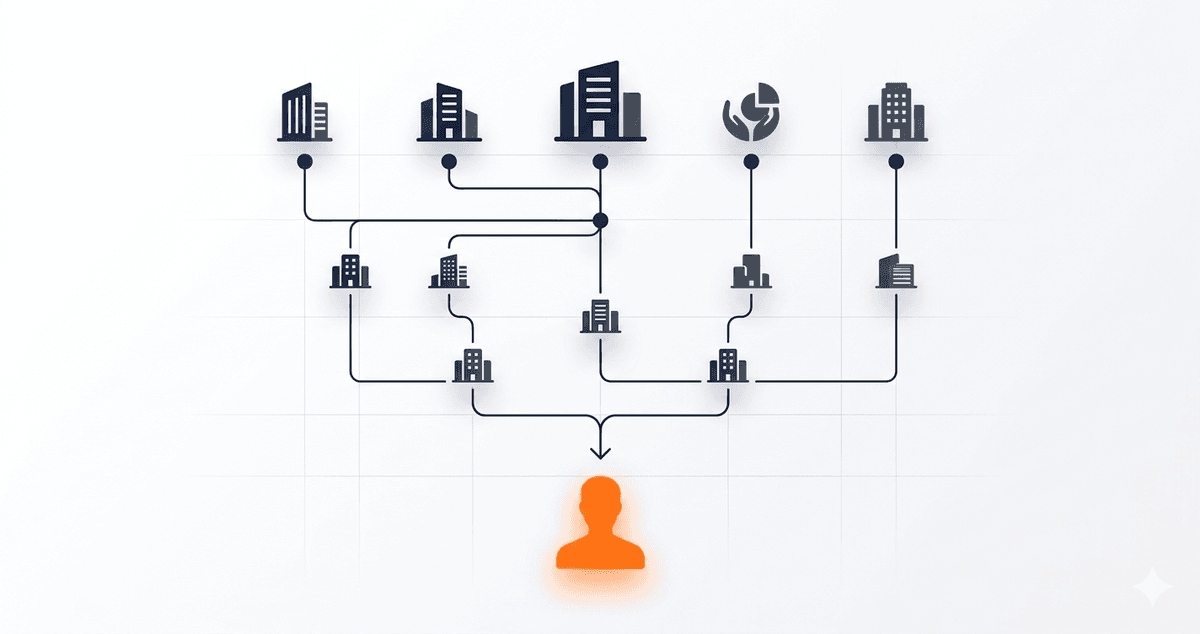
You've registered with AUSTRAC. You've started building your AML/CTF program. But when a new client walks in — a company, trust, or partnership — do you know how to identify who actually owns and controls it?
Beneficial ownership verification is one of the most critical parts of customer due diligence (CDD), and it's where many Tranche 2 businesses will struggle. Here's how to get it right.
What Is a Beneficial Owner?
A beneficial owner is a natural person (a real human being) who ultimately:
- Owns 25% or more of a customer entity, or
- Controls the entity (even without ownership), or
- Benefits from the entity's assets or income
The key word is ultimately. It's not enough to identify the company that holds shares — you must trace through layers of ownership until you reach a real person.
Why It Matters
Criminals use complex corporate structures specifically to hide beneficial ownership. Common tactics include:
- Layered companies: Company A owns Company B, which owns Company C — the real owner sits behind multiple layers
- Nominee arrangements: A nominee director or shareholder holds shares on behalf of the true owner
- Trusts: Discretionary trusts allow controllers to distribute benefits without formal ownership
- Foreign entities: Offshore companies in jurisdictions with weak transparency requirements
If you don't identify the true beneficial owner, your entire CDD process fails — and you may be facilitating money laundering without knowing it.
The 25% Threshold
Under the reformed AML/CTF Act, the standard beneficial ownership threshold is 25% or more of:
- Voting rights in a company
- Shares or equity in a company
- Capital or profits in a partnership
- Income or property of a trust
But ownership isn't the only trigger. Control matters too. A person can be a beneficial owner with 0% equity if they:
- Have the power to appoint or remove directors
- Control board decisions through agreements or influence
- Are the settlor, trustee, or appointor of a trust
- Have a general power of attorney over the entity
Identification by Entity Type
Companies (Pty Ltd, Ltd)
- Check the ASIC register for current shareholdings and directorships
- Trace through any corporate shareholders to find the natural persons holding 25%+
- Identify anyone with control — even if they own no shares (e.g., through shareholder agreements, casting votes)
- If no individual meets the 25% threshold, identify the senior managing official(s) — typically the CEO or managing director
Common trap: A company has 5 shareholders each with 20%. No single person triggers the 25% threshold. You must still identify the senior managing official as the beneficial owner.
Trusts
Trusts are the most complex structure for beneficial ownership. You need to identify:
| Role | Why They're Relevant |
|---|---|
| Trustee | Controls trust assets — always a beneficial owner |
| Settlor | Created the trust — relevant if they retain influence |
| Appointor/Guardian | Can remove and appoint trustees — significant control |
| Named beneficiaries | Entitled to trust income or capital |
| Classes of beneficiaries | Describe the class if individuals can't be identified (e.g., "grandchildren of the settlor") |
For discretionary trusts (the most common in Australia), there are no fixed beneficiaries — the trustee decides distributions each year. Focus on:
- Who is the trustee (and who controls the corporate trustee)?
- Who is the appointor?
- Who has received distributions in practice?
Partnerships
- Identify all partners holding 25% or more of capital or profits
- For limited partnerships, include both general and limited partners
- If no partner meets the threshold, identify the partner(s) with management control
Self-managed Super Funds (SMSFs)
- Identify all individual trustees (or directors of the corporate trustee)
- Identify all members of the fund
- SMSFs are limited to 6 members, so you'll typically identify everyone
Associations and Not-for-Profits
- Identify office holders (president, secretary, treasurer)
- Identify anyone with effective control over the entity's operations
Verification: What Evidence Do You Need?
Identifying a beneficial owner isn't enough — you must verify their identity. The standard for verification:
Minimum Documentation
- Full legal name (verified against government-issued photo ID)
- Date of birth
- Residential address (not a PO Box)
Ownership Structure Evidence
| Entity Type | Acceptable Evidence |
|---|---|
| Company | ASIC company extract, share register, constitution |
| Trust | Trust deed (especially schedule of beneficiaries and appointor clauses) |
| Partnership | Partnership agreement |
| SMSF | SMSF trust deed, ATO registration confirmation |
| Foreign entity | Equivalent registry extract from the home jurisdiction |
When to Request the Trust Deed
Always. If a client operates through a trust and won't provide the trust deed, that's a red flag. You need to see:
- The appointor clause (who can remove the trustee?)
- The beneficiary schedule (who benefits?)
- Any amendments (has control shifted since the trust was established?)
Common Pitfalls
1. Accepting the Company Name as the Beneficial Owner
"ABC Pty Ltd" is not a beneficial owner. A company is never the final answer — you must trace through to natural persons.
2. Stopping at the First Layer
A client says "John Smith owns 100% of the shares." But does John hold those shares beneficially, or as a nominee? Ask.
3. Ignoring Control Without Ownership
A minority shareholder who controls the board through a shareholder agreement is a beneficial owner. Ownership percentage alone doesn't tell the full story.
4. Not Updating UBO Information
Beneficial ownership changes. Directors resign, shares are transferred, trustees are replaced. You must update your UBO records when you become aware of changes — and actively check at least annually.
5. Not Documenting Your Reasoning
If you can't identify a beneficial owner (e.g., a widely held public company), document why and record the senior managing official instead. AUSTRAC wants to see your process, even when the answer is "no individual meets the threshold."
Enhanced Due Diligence Triggers
Some beneficial ownership situations demand enhanced due diligence (EDD):
- The beneficial owner is a politically exposed person (PEP) — a foreign government official, senior executive of a state-owned enterprise, or their family/associates
- The ownership structure is unusually complex with no clear business rationale
- The entity involves high-risk jurisdictions (countries identified by FATF as having weak AML controls)
- The client refuses to disclose beneficial ownership information
- There are discrepancies between declared ownership and publicly available information
EDD means collecting more information, senior management sign-off, and ongoing enhanced monitoring.
Practical Workflow
Here's a step-by-step process you can follow for every new business client:
- Ask the client to complete a beneficial ownership declaration form
- Verify the structure against public records (ASIC for companies, ATO for SMSFs)
- Request supporting documents — trust deeds, partnership agreements, shareholder registers
- Trace through layers until you reach natural persons
- Verify each beneficial owner's identity using government-issued photo ID
- Screen beneficial owners against sanctions lists (DFAT consolidated list) and PEP databases
- Assess the risk — does the ownership structure make sense for the client's stated business?
- Record everything — your findings, your reasoning, and the evidence collected
- Set a review date — check beneficial ownership at least annually or when triggered by changes
What to Do When Clients Push Back
Some clients will resist providing beneficial ownership information. Common objections and responses:
| Objection | Response |
|---|---|
| "That's private information" | "We're legally required to collect this under the AML/CTF Act. We can't proceed without it." |
| "You didn't need this before" | "New regulations from 1 July 2026 require us to verify beneficial ownership for all clients." |
| "Just put it in my company name" | "We need to identify the natural persons who own or control the company — that's a legal requirement." |
| "I don't have the trust deed handy" | "We can proceed with initial services once we have it. Please provide it within [timeframe]." |
If a client refuses to provide beneficial ownership information, you cannot proceed with the designated service. Full stop. This is not negotiable under the AML/CTF Act. Document the refusal and consider filing a suspicious matter report (SMR) if the refusal itself is suspicious.
Record Keeping
Beneficial ownership records must be kept for 7 years after the business relationship ends. This includes:
- The beneficial ownership declaration
- Copies of identity documents used for verification
- ASIC extracts, trust deeds, or other structural documents
- Your risk assessment notes
- Any enhanced due diligence documentation
- Records of any changes to beneficial ownership during the relationship
Need help managing beneficial ownership for your clients? AML Mate's client management system tracks UBOs, screens against sanctions lists automatically, and flags when reviews are due. Start your 14-day free trial, cancel anytime.