
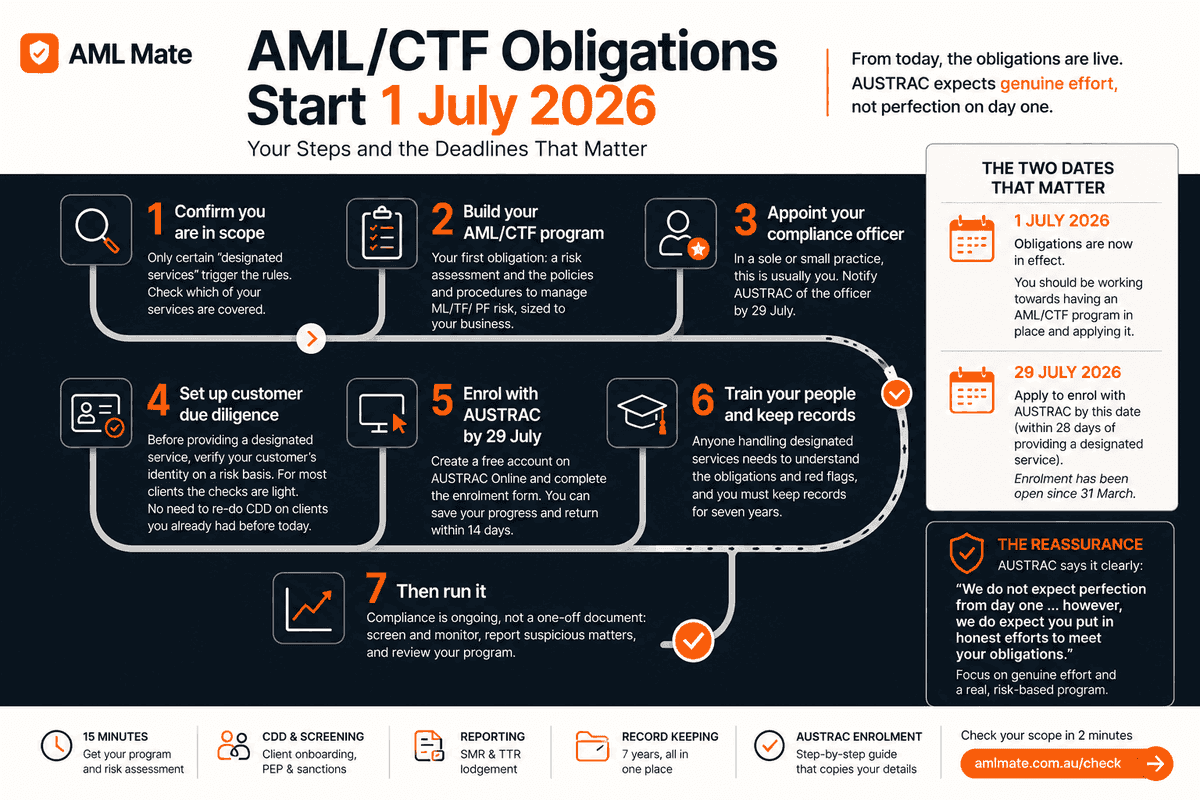
From today, the businesses newly covered by Australia's AML/CTF reforms are inside the regime. If you are an accountant, lawyer, conveyancer, real estate agent or a dealer in high-value goods providing a designated service, your obligations are now live. If you are not fully ready, take a breath. This post is the plain-English version: the dates that actually matter, the steps you need to take, and where to start today.
First, the reassurance, in AUSTRAC's own words
The deadline feeling is real, but 1 July is a start, not a cliff edge. AUSTRAC's CEO put it directly to professional service firms: "we do not expect perfection from day one ... however, we do expect you put in honest efforts to meet your obligations." (AUSTRAC, AML information session for barristers and solicitors (opens in a new tab)) After 1 July, AUSTRAC says its enforcement focuses on businesses that wilfully ignore the rules, not those making a genuine start. So the goal for today is simple: begin, in good faith.
The two dates that matter
- 1 July 2026. Obligations are now in effect. You should be working towards having an AML/CTF program in place and applying it.
- 29 July 2026. You must apply to enrol with AUSTRAC by this date (within 28 days of providing a designated service). Enrolment has been open since 31 March. (AUSTRAC, enrol with us (opens in a new tab))
Note for most professional firms: you generally only need to enrol, not "register". Registration is a separate step for money remitters and virtual asset providers. One less thing to worry about.
The steps, in order
This is the whole job. It is more manageable than it looks once it is broken down.
- Confirm you are in scope. Only certain "designated services" trigger the rules. A trust account handling client money, property and estate work, and company or trust formation are the usual triggers. Check which of your services are covered. (Confirm your scope in two minutes)
- Build your AML/CTF program. This is your first obligation: a risk assessment of money laundering, terrorism financing and proliferation financing risk, plus the policies and procedures to manage it, sized to your business. (What "a program in place" actually requires)
- Appoint your AML/CTF compliance officer. In a sole or small practice, this is usually you. AUSTRAC must be notified of the officer by 29 July.
- Set up customer due diligence (CDD). Before providing a designated service, verify your customer's identity, on a risk basis. For most clients the checks are light. You do not need to re-do CDD on clients you already had before today.
- Enrol with AUSTRAC by 29 July. Create a free account on AUSTRAC Online and complete the enrolment form. You can save your progress and return within 14 days.
- Train your people and keep records. Anyone handling designated services needs to understand the obligations and red flags, and you must keep records for seven years.
- Then run it. Compliance is ongoing, not a one-off document: screen and monitor, report suspicious matters, and review your program. (How the program runs day to day)
If you are starting late
You are not alone, and you are not out of time. The honest measure today is genuine effort: a real, risk-based program that you are actually following, and a plan to enrol by 29 July. (What AUSTRAC expects if you are not fully ready) Start with one step, not all seven at once.
Where AML Mate fits
AML Mate is built to do the heavy lifting of the list above. Tell us about your practice and it generates a risk-based AML/CTF program and risk assessment in about 15 minutes, then keeps the operating trail as you go: client onboarding with CDD, dated PEP and sanctions screening, SMR and TTR lodgement, training records, seven-year record keeping, and a step-by-step AUSTRAC enrolment guide that copies your details straight into the form. Not sure you are even in scope? The free compliance check tells you in two minutes, with no login. Then start a 14-day free trial, cancel anytime, and turn 1 July from a deadline into a plan.