
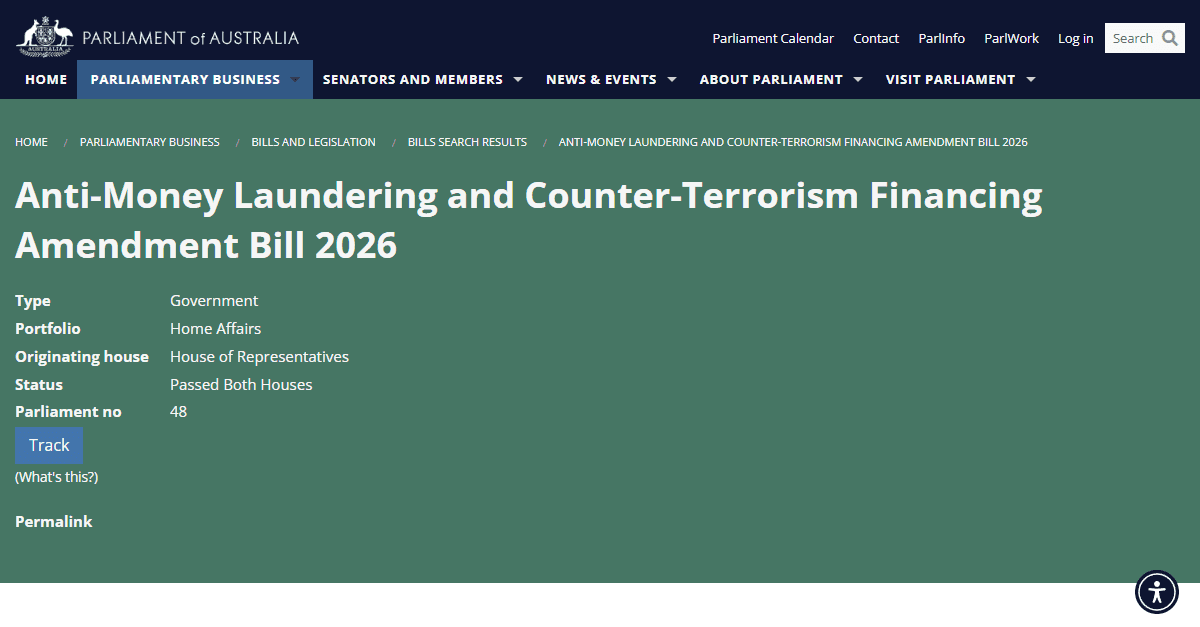
On Monday 16 November 2026 the Senate passed the Anti-Money Laundering and Counter-Terrorism Financing Amendment Bill 2026 without changing it. The House had passed it on 16 September, so Parliament's record now reads "Finally passed both Houses". (Parliament of Australia, bill homepage (opens in a new tab))
It is not law yet. As of 18 November the bill is waiting for Royal Assent, and almost nothing in it starts before that.
Most of what you will read about it is about cryptocurrency ATMs. That is fair: Schedule 1 is the big new power. But if you run an accounting practice, a law firm or a real estate agency, the lines that touch your Tuesday are further back, in a schedule titled "Technical amendments". This post covers both, in that order, and everything below is from the text as passed and its revised explanatory memorandum, both linked from the bill homepage.
The headline: a power to restrict high-risk products
Schedule 1 adds a new Part 6B to the AML/CTF Act. Under new section 77A, the Minister may, by legislative instrument, "restrict or prohibit a reporting entity from using a product, service, delivery channel or thing" to provide a designated service. The bill calls that product or channel a high-risk mechanism.
The Minister has to be satisfied of two things: that using the mechanism "has caused, will cause or is likely to cause, significant harm" to the financial system or the Australian community, and that the restriction is necessary in the public interest.
The explanatory memorandum's example is "exchanging money for virtual assets via a cryptocurrency ATM". Its other examples are offshore virtual asset service providers and remittance providers with no physical presence in Australia that target Australian customers.
Four details are worth knowing, because the bill changed on its way through.
- The power sits with the Minister, not AUSTRAC. The bill as introduced in March gave it to the AUSTRAC CEO. The House agreed to 25 government amendments on 16 September, after the Parliamentary Joint Committee on Intelligence and Security reported on the bill in August. In the version that passed, the Minister decides, but "must seek advice from the AUSTRAC CEO and must have regard to that advice".
- AUSTRAC runs the consultation. The Minister cannot make an instrument unless the AUSTRAC CEO has consulted the people likely to be affected, for at least 30 days. The exception is where the Minister is satisfied that "exceptional or urgent circumstances" justify skipping it.
- Restrictions expire. An instrument made after consultation can run for up to 3 years. One made without consultation can run for no more than 6 months. The explanatory statement for each instrument has to describe the consultation AUSTRAC carried out, if any.
- It starts on 1 July 2027. The introduced bill said 1 January 2027. The passed text gives everyone six more months.
Breaching a restriction, or offering a service that would breach one, is an offence carrying up to 4 years imprisonment or 1,000 penalty units, or both. Each is also a civil penalty provision.
Does this reach Tranche 2 firms? On paper, yes. The power is written for "a reporting entity", and you are one. In practice, nothing in the bill or the memorandum points at professional services, and there is no instrument yet. The first one cannot be made before 1 July 2027, and you would normally see a 30 day consultation on AUSTRAC's website first.
The part for your practice: Schedule 3
Schedule 3 fixes things that turned up while the 2024 reforms were being implemented. Five of those fixes are worth a line in your notes.
1. No more PEP check on the person acting for your client
Today, initial customer due diligence means establishing whether four kinds of people are politically exposed persons: the customer, any beneficial owners, any person on whose behalf the customer is receiving the service, and any person acting on behalf of the customer. (AUSTRAC, overview of initial customer due diligence (opens in a new tab))
That last one is the attorney signing under a power of attorney, or the director instructing you for the company.
The bill rewrites paragraph 28(2)(e) of the Act so the PEP question stops at the first three. The memorandum's reason is that the international standard focuses on "whether the customer is a politically exposed person, not whether a person acting on behalf of the customer is a politically exposed person", and that removing the step "will significantly reduce regulatory burden".
Two things do not change.
- Sanctions screening still covers the agent. The new paragraph keeps "any person acting on behalf of the customer" in the list for targeted financial sanctions. (AUSTRAC, persons designated for targeted financial sanctions (opens in a new tab))
- You still identify the agent and check their authority. Establishing "the identity of any person acting on behalf of the customer, and their authority to act" stays on AUSTRAC's list. (AUSTRAC, overview of initial customer due diligence (opens in a new tab)) The bill removes one question about them, not the person.
The matching trigger for enhanced due diligence is trimmed the same way. Under the new paragraph 32(c), a foreign PEP triggers enhanced CDD when they are the customer, a beneficial owner, or the person the customer is acting for. An agent who happens to be a foreign PEP no longer does on that ground alone. If a screening hit does land on someone in the first three groups, what to do with a PEP or sanctions match is unchanged.
The change applies to a designated service you start providing on or after commencement. Until then, the four-person list is still the law.
2. "I had no doubts" stops being an answer
Ongoing CDD currently requires you to review, and where appropriate update and re-verify, a client's know your customer information where "the reporting entity has doubts about" its adequacy or veracity. The bill replaces those words with "there are reasonable grounds for the reporting entity to doubt".
The memorandum is direct about why. The trigger "is not intended to rely on the subjective view of the reporting entity", nor on whether a doubt actually arose "in situations where such a doubt should, objectively, have arisen". It calls the change "a strengthening of the standard for ongoing CDD".
In plain terms: the question a reviewer asks later is not whether you doubted the client's details. It is whether a reasonable firm, holding what you held, would have. Think of a returned letter, a new director on an ASIC extract, or an ID that expired two years ago. Under an objective test, what counts is that the grounds were there, not whether anyone in the office noticed.
This one applies to existing clients too. The bill says it covers a business relationship "whether the relationship began before, on or after the commencement". If your ongoing monitoring depends on someone remembering to have a doubt, this is the amendment to read twice.
3. Not following your own policies can become an infringement notice
Section 26G of the Act requires a reporting entity to comply with its AML/CTF policies. The bill adds subsections 26G(1) and (2) to the definition of "designated infringement notice provision".
So far the Tranche 2 infringement notices AUSTRAC has published are all about one missed enrolment form. This amendment puts "has a program, does not follow it" on the list of things a notice can be issued for. It applies only where the conduct happens wholly on or after commencement.
A program copied from a template and filed is a bigger risk after this bill than before it. The policies in it are now a list of things you have said you will do.
4. AUSTRAC can ask enrolled businesses for more enrolment details
Right now you must tell AUSTRAC when your enrolment details change, within 14 days. (Our guide to the 14 day rule) What the Act does not cover is the case where AUSTRAC changes what counts as an enrolment detail. The memorandum notes that already-enrolled businesses "are not required to update those details", which "may cause the reporting entities roll to contain incorrect reporting entity information".
The bill closes that gap. The AML/CTF Rules will be able to require enrolled businesses to provide enrolment details of a kind the Rules specify, within a period the Rules set. Changes to your details stay on the 14 day clock.
Nothing is due under this yet. It is a power to make Rules, and it starts the day after Royal Assent. If AUSTRAC later adds a field to the enrolment form, expect to be asked to fill it in.
5. For lawyers: the LPP form goes back to whoever sent the notice
Where a notice under section 49 or section 202 asks for information and you claim legal professional privilege, the Act currently has you give the LPP form to the AUSTRAC CEO. But those notices can come from other agencies. The bill changes the recipient: the form goes to "the issuer" of the notice, which the memorandum says "may be an agency other than the AUSTRAC CEO". It applies to notices given on or after commencement. Our LPP form guide covers the form itself.
And one for firms with an overseas office
The bill also redefines domestic and foreign PEPs around two new terms, "Australian politically exposed person" and "non-Australian politically exposed person", so the labels work when a service is provided through a permanent establishment in another country. For a practice that only operates in Australia, a domestic PEP is still an Australian one and a foreign PEP is still a non-Australian one. (AUSTRAC, politically exposed persons (opens in a new tab))
When each part starts
| Part of the bill | Starts |
|---|---|
| High-risk mechanism power (Schedule 1) | 1 July 2027 |
| Financing of terrorism definition (Schedule 2) | 28 days after Royal Assent |
| CDD and PEP changes (Schedule 3, Parts 1 and 2) | The day after Royal Assent, or when Schedule 2 of the 2024 amending Act commences if that is later |
| LPP form recipient (Schedule 3, Part 3) | The day after Royal Assent, or when Schedule 4 of the 2024 amending Act commences if that is later |
| Enrolment details power (Schedule 3, Part 4) | The day after Royal Assent |
| Infringement notices for section 26G (Schedule 3, Part 7) | The day after Royal Assent, or when Schedule 2 of the 2024 amending Act commences if that is later |
Schedule 2 widens the definition of financing of terrorism to pick up new offences for financing a state sponsor of terrorism, and sanctions offences prescribed by regulation. It matters for suspicious matter reporting, because that is one of the things a suspicion can relate to, but it does not add a new step to your process.
What to do this week
Nothing in your procedures needs to change today, and one thing should not.
- Do not drop the agent PEP check early. The bill has passed. It has not commenced. AUSTRAC's guidance still lists the person acting on behalf of the customer, and it is still the law until the day after Royal Assent.
- Find the sentence in your program. Search your customer due diligence policy for the PEP step and note where it mentions people acting for a client. When the change commences and AUSTRAC updates its guidance, that is the sentence to revise. Keep sanctions screening for agents exactly as it is.
- Write down your re-verification triggers. List the events that give you reasonable grounds to doubt a client's details, and who checks for them. That is cheap now and useful once the objective test applies.
- Read your own policies as a to-do list. For each "we will", ask whether there is a record showing you did. That is the test behind an infringement notice under section 26G.
- Watch for Royal Assent. The bill homepage will show it, and the dates in the table above run from it.
Where AML Mate fits
AML Mate keeps your client due diligence records, screening results and review dates in one place, next to the program they are meant to follow. When an amendment like this one commences, the question is rarely what the law says. It is whether you can show what you did for each client, and when. If you are not sure which obligations apply to your business at all, the free compliance check starts there. No signup needed.
A bill sold on crypto ATMs has passed. For a three-partner practice, its lasting effect is quieter: one question fewer about your client's agent, and a firmer expectation that you notice when a client's details have gone stale.
This article is general information, not legal advice. For advice specific to your circumstances, consult a qualified AML/CTF professional.